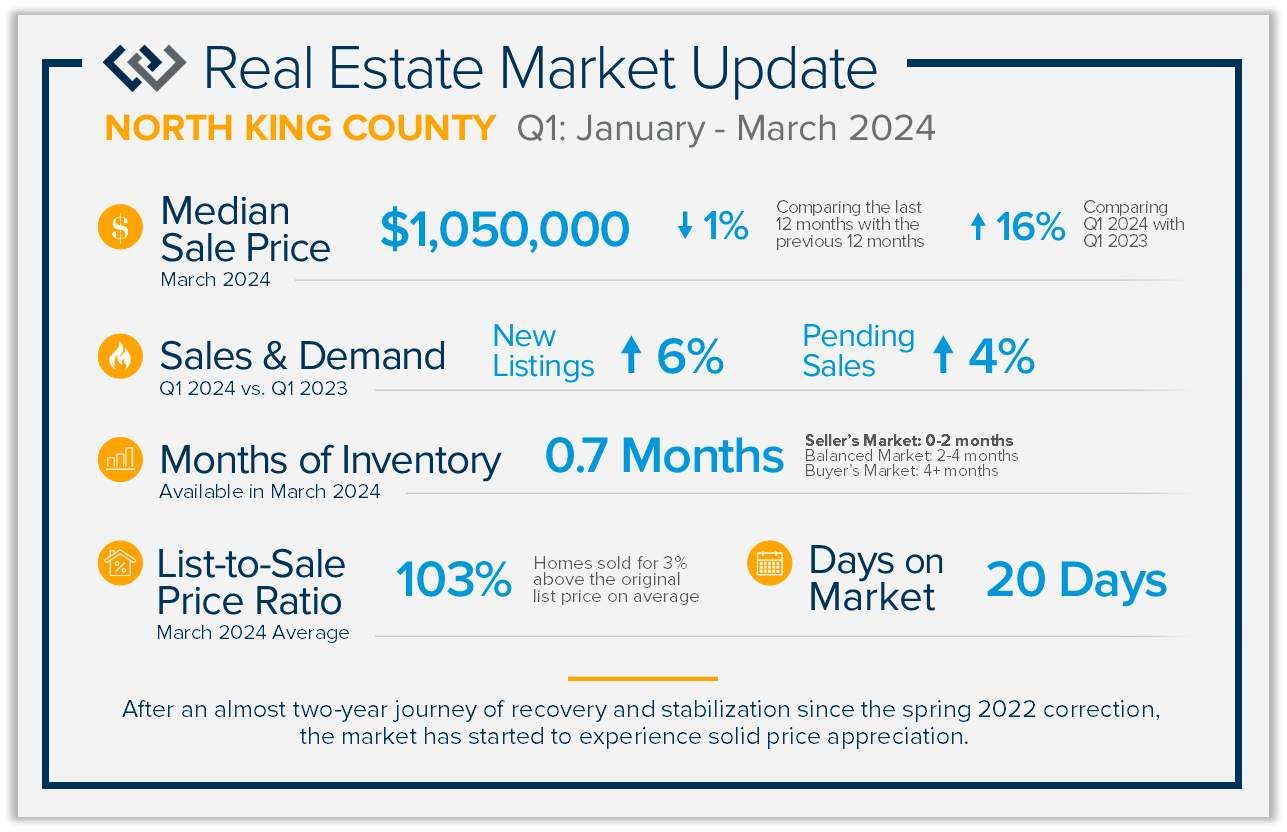
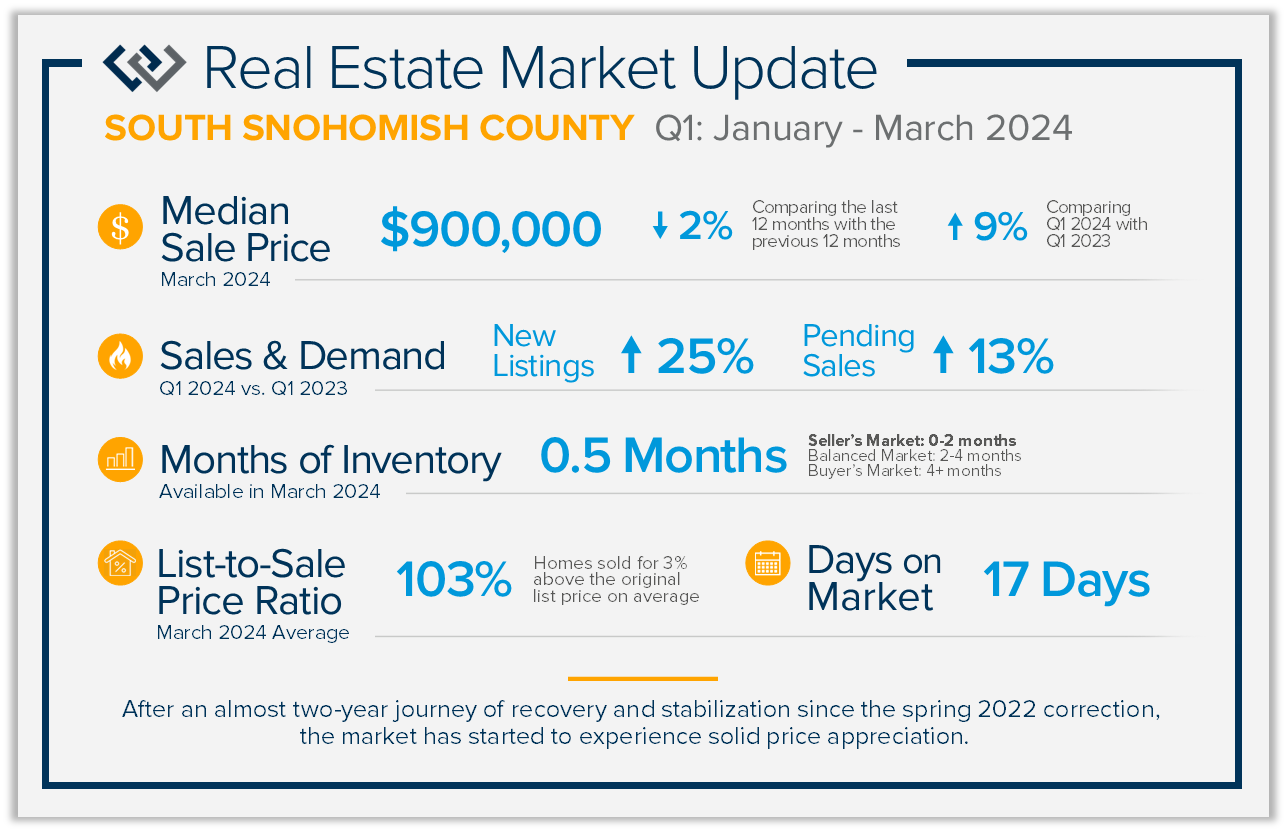
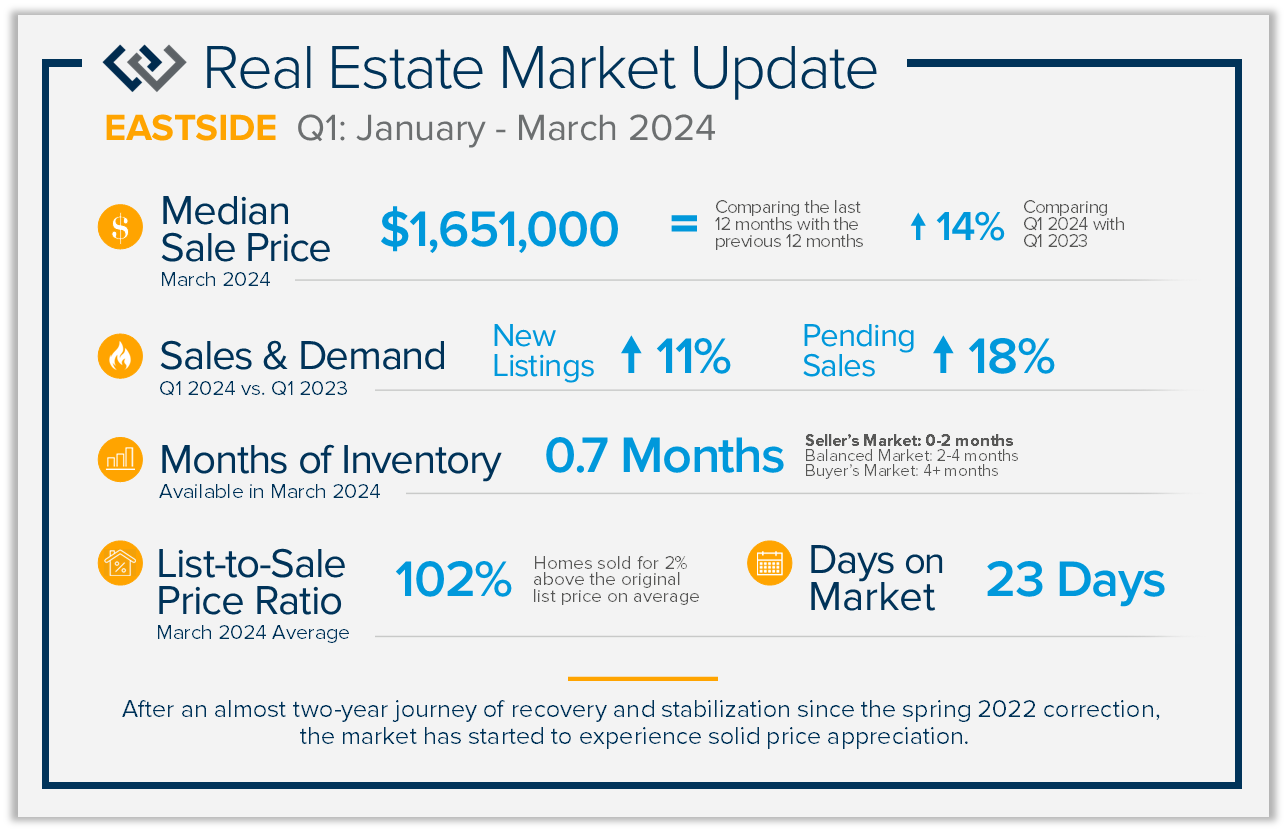
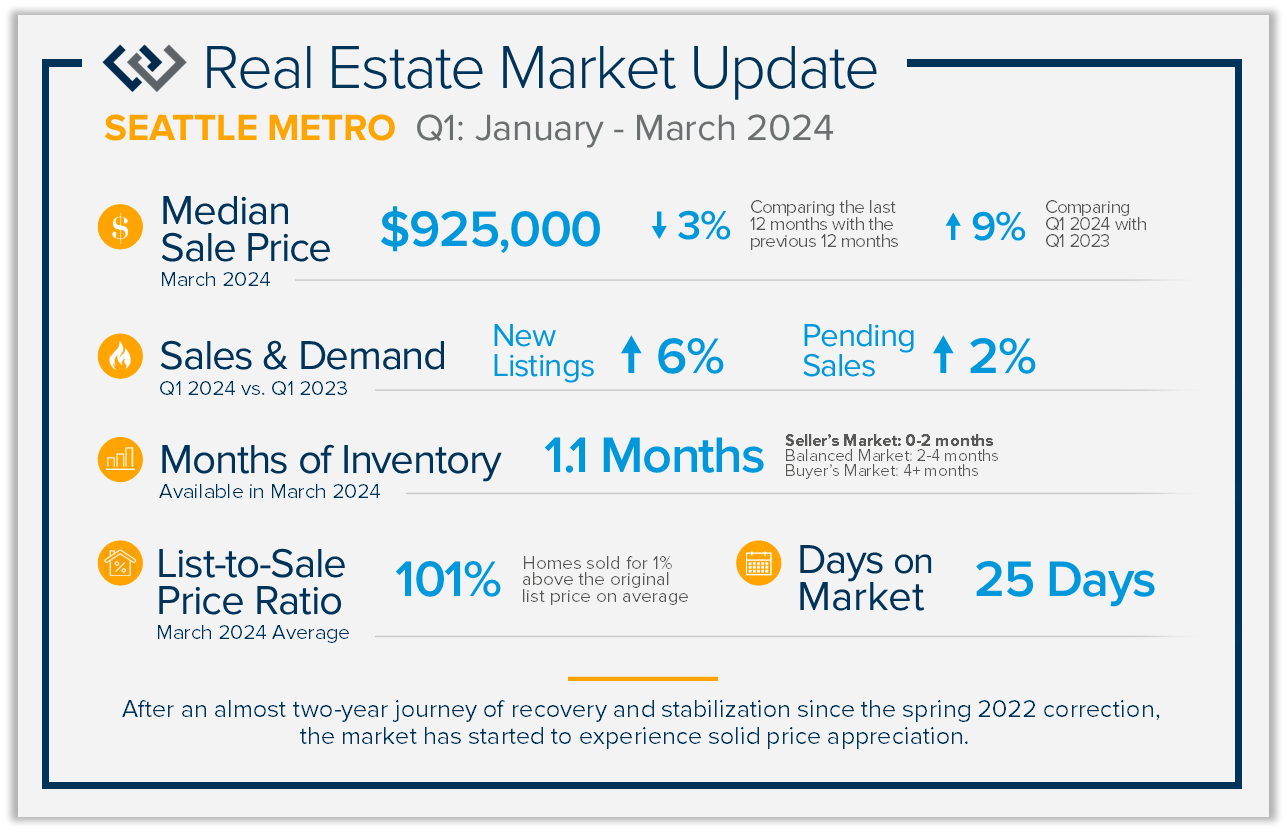
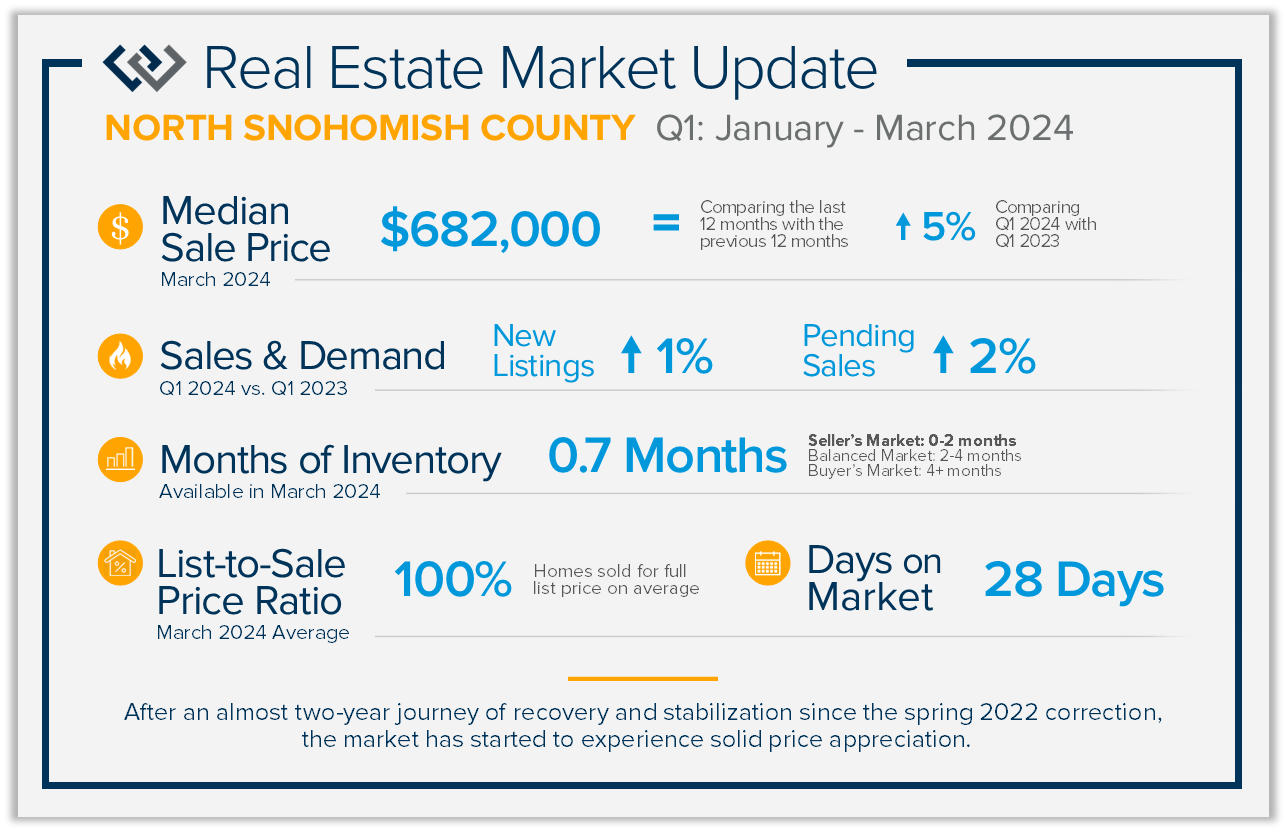
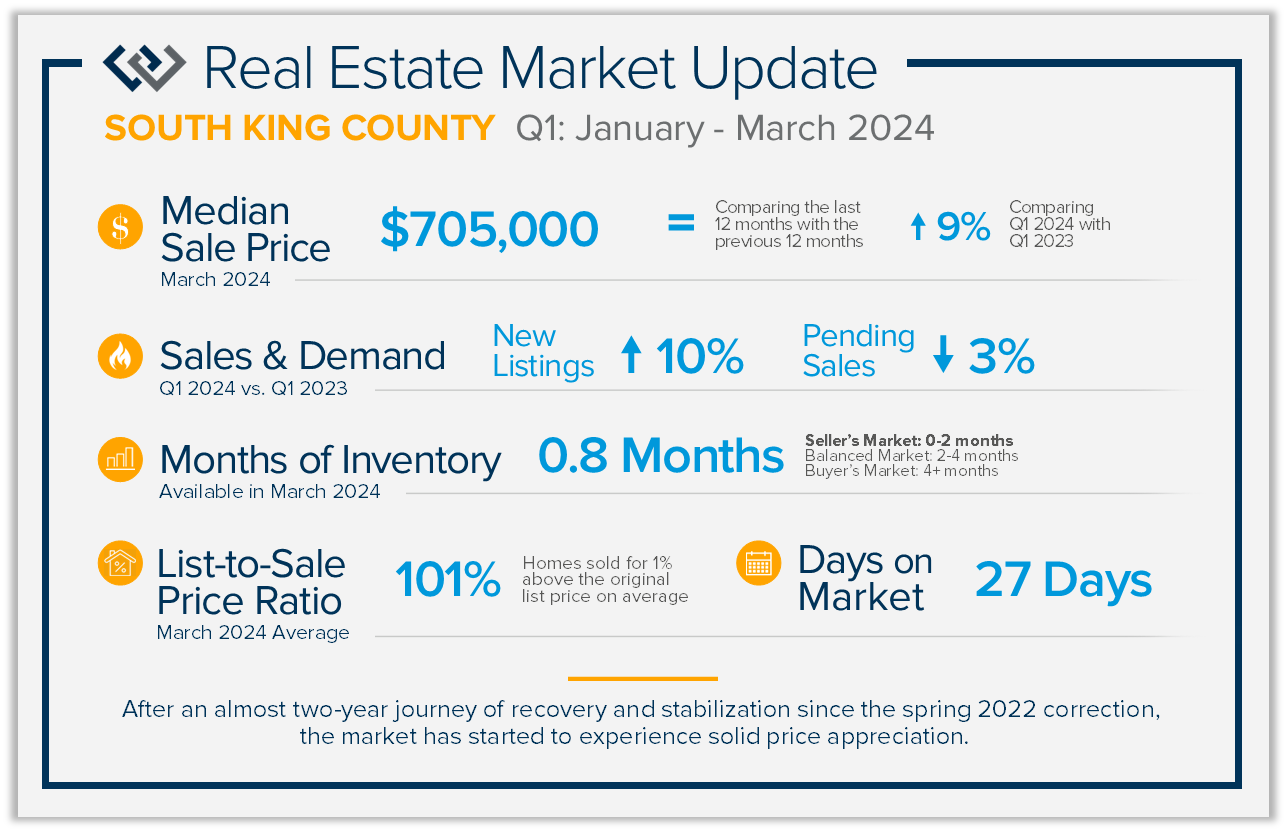
After an almost two-year journey of recovery and stabilization since the spring 2022 correction, the market has started to experience solid price appreciation. The median price in Q1 2024 vs. Q1 2023 shows that despite interest rates remaining stubborn, buyer demand is returning to the market. Improved consumer confidence and acclimation to lending costs have caused price growth, especially amongst tight inventory levels.
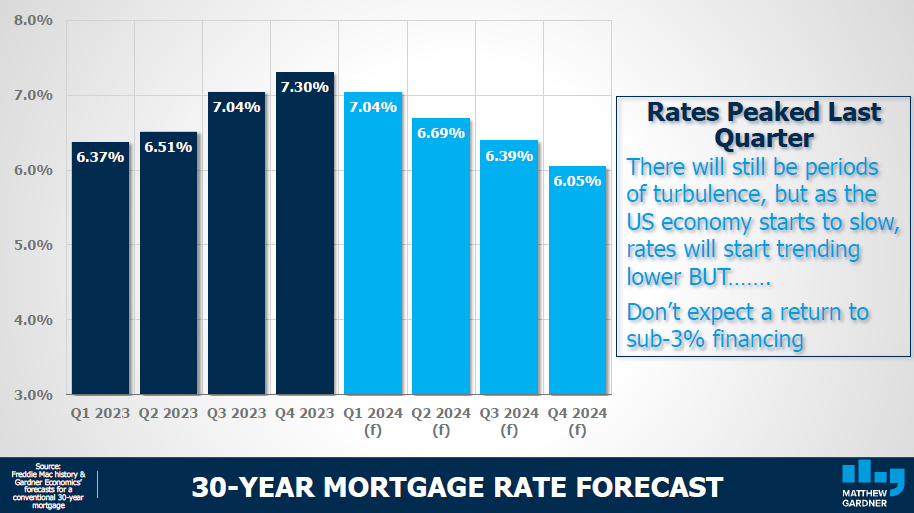
New listings are slowly increasing over 2023 as pent-up seller demand meets the market. Equity levels across our region are strong, providing favorable returns for home sellers. Many experts predict interest rates to gradually fall in 2024, estimating they will reach the mid to lower 6% range later this year. While the cost of lending still has some buyers sidelined, many are forging ahead now.
Life changes often determine a move. It is my goal to help empower strong decisions by assessing my client’s lifestyle and financial goals amidst real-time market trends and conditions. Whether you have considered selling, buying, or both, or you’re just curious about the market, please reach out.
As I am sure you have heard on the news, there is a proposed settlement agreement for the NAR (National Association of Realtors) Class Action Lawsuit. It has certainly stirred up plenty of headlines that have been glossy, and in many cases, inaccurate. Many of the reports and headlines have been national and it is important to note that WA state is unique and could have far fewer changes than the rest of the country if the settlement is approved.
The majority of the MLSs (Multiple Listing Services) across the country are owned by NAR and our NWMLS (Northwest Multiple Listing Service) in WA, is not. NWMLS is not included in the settlement agreement as they are not NAR-owned. If the settlement is approved, they can choose to opt in, which is undecided at this point as it will require a vote of their board of directors.
In WA, new laws were enacted on January 1, 2024 that address many aspects that the settlement agreement is proposing. For years, WA brokers and NWMLS have been committed to elevating transparency around broker compensation, resulting in brokers in WA already doing business as many of the new proposals in the settlement agreement suggest. You can refer to the newsletter I sent out in early February that outlines the new laws that went into place on Jan 1. I am also happy to report that practicing under these new laws has been positive and productive for consumers and brokers alike.
The proposed settlement agreement still needs to be approved by the court. Once that is done, I will report back to explain how it will affect real estate operations in WA state. In the meantime, I also want to report that market activity in Q1 2024 has been positive!
Price growth is up, buyer demand is strong, and inventory remains low. Seller equity is soaring, with home equity in King County averaging 60% and 57.5% in Snohomish County. These figures were reported in December 2023 and don’t account for the price growth we’ve seen in Q1. Interest rates are still hovering around the high 6% and are predicted to come down this year, yet remain volatile and stubborn. Please reach out if you or someone you know would like to learn more. It is always my goal to help keep my clients informed and empower strong decisions.
When Punxsutawney Phill climbed up to his perch at Gobblers Knob on February 2nd and did not see his shadow, an early spring was predicted. Little did we know that he would be referring to the real estate market! As we experience temps in the 30s and scattered snow showers in the first week of March, we are also experiencing a white-hot seller’s market.
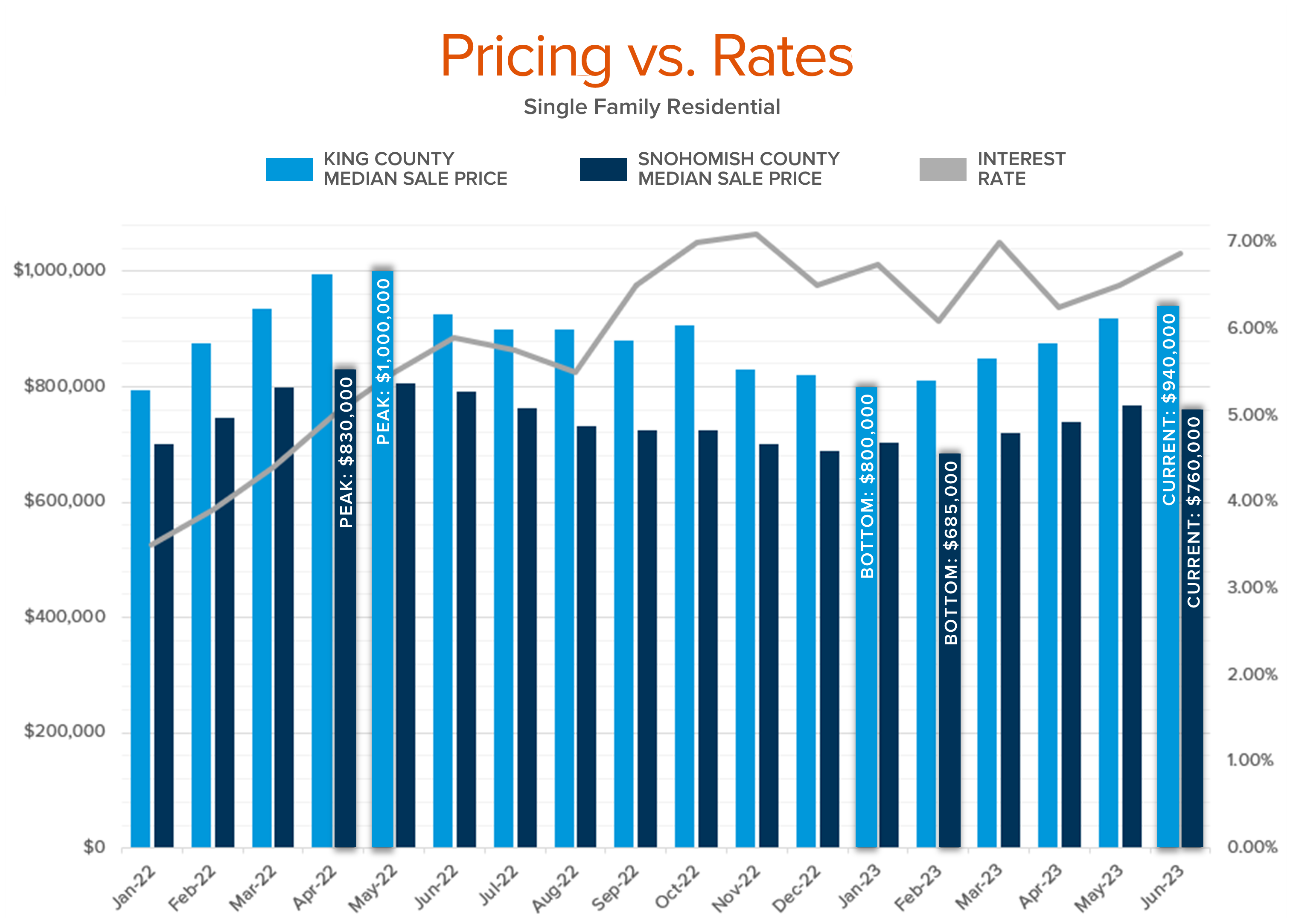
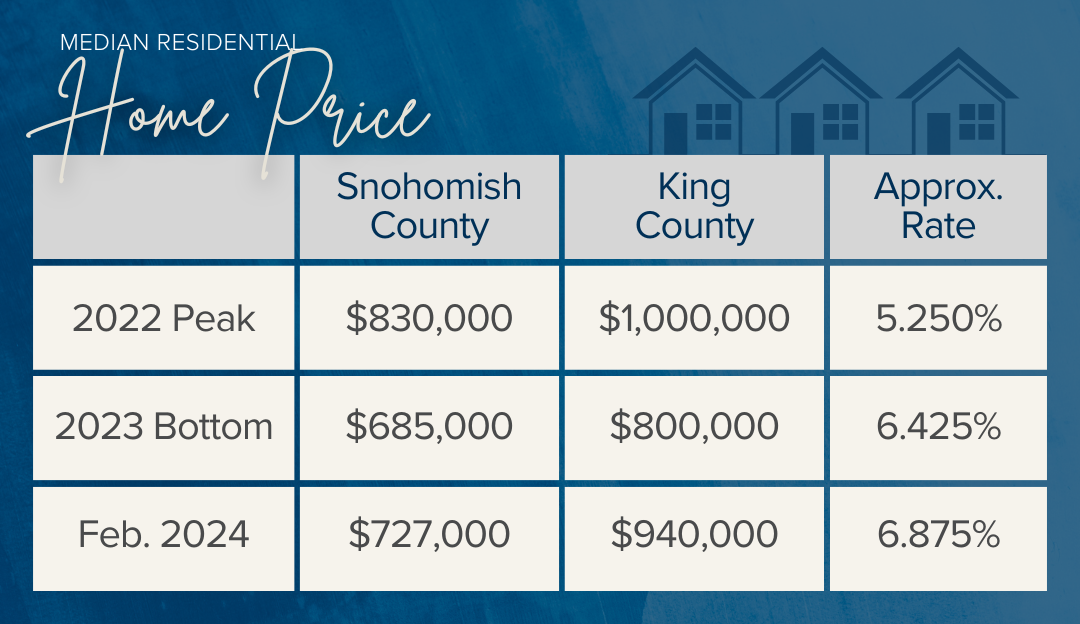
We started 2024 with the lowest amount of inventory we have seen since the beginning of 2022. Over the last 2 years, we have experienced a correction and recovery in the real estate market due to inflation and interest rates. The market peaked in April 2022 in Snohomish County when the median price reached $830,000, and in May 2022 in King County when prices reached $1M. Prices started to correct when rates crested 5% in April 2022 and then found themselves squarely at 7% by October 2022. This rapid 2-point increase put downward pressure on prices and stalled buyer and seller demand.
Loan servicing affordability caused prices to bottom out in Snohomish County in February 2023 at $685,000, and in King County in January 2023 at $800,000. The bulk of the correction took place in 2022, and 2023 was the year of resetting price stability and the return of appreciation. What was fascinating about this growth is that interest rates still averaged around 7% throughout 2023.
In Snohomish County prices were up 6% in February 2024 over February 2023, and in King County they were up 16%, and rates are still hanging around 7%. Since the first of the year, it was like a switch went off for many buyers and demand flooded the market. The feedback that I am hearing is that many buyers have adapted to the new normal of interest rates and will refinance when rates come down; but they want to buy now. The increase in buyer demand coupled with the lowest inventory we’ve seen in two years has caused a flurry of multiple offers, price escalations, and an early start to the spring market.
Now that we are certain buyers are back, the next effective change in the market would be the addition of more inventory. This would meet the demand and create more movement in the market. We are well aware that many homeowners are reluctant to make a move because they don’t want to give up their low rate/payment. We also know that because of this, many would-be sellers are living in homes that do not match their needs and wants.
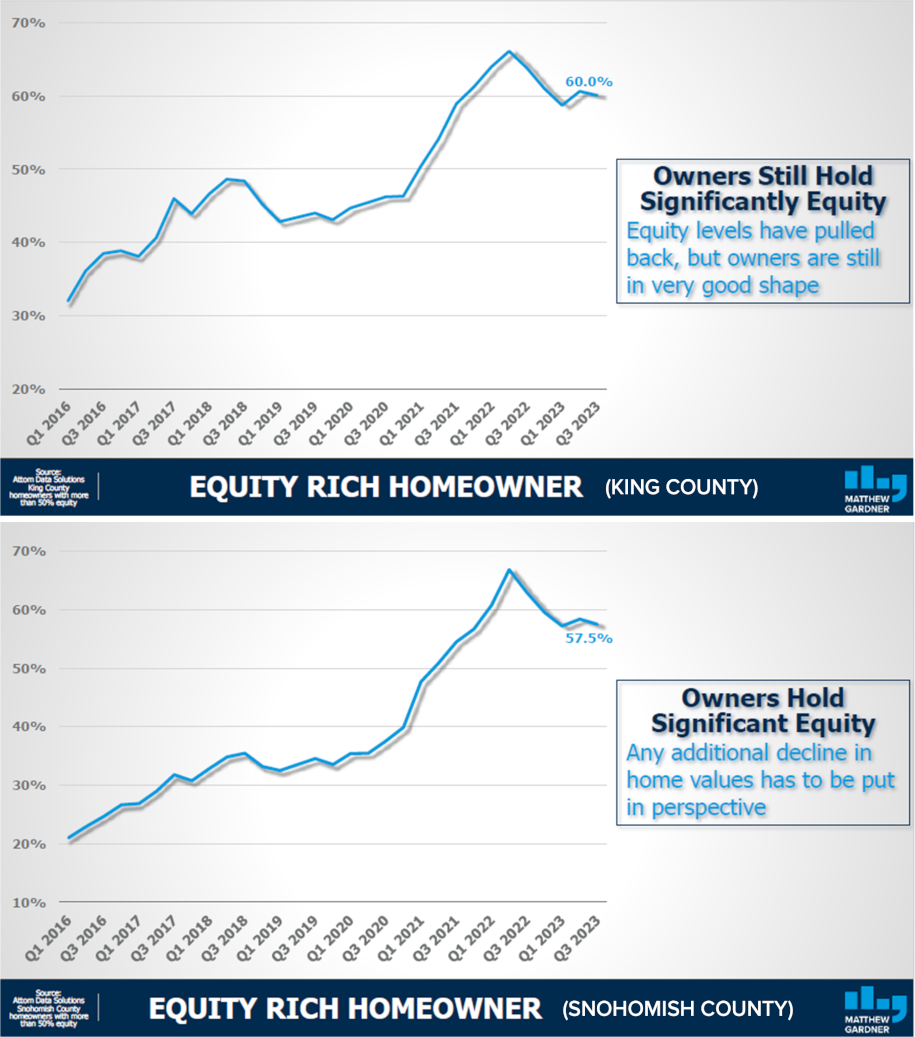
This pent-up seller demand is starting to come to market, but more is needed. The average level of equity in Snohomish County was reported at the end of 2023 at 57.5% and in King County at 60%. With the recent uptick in median price, this level is growing, which will allow many sellers to move their equity into a home that better fits their lifestyle. This growth should also be supported by interest rates slowly coming down throughout 2024.
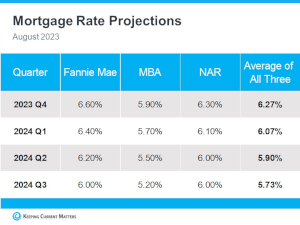
The latest predictions from the Home Price Expectation Survey (HPES) have rates decreasing to 6% by the end of 2024 which will only add to buyer demand, highlighting the need for more listings. If you are a homeowner and your house is not matching your life, now might be the time to consider a move! What has already transpired in the first 2 months of 2024 has been encouraging for seller gains.
Writing a playbook and creating a strategy to make these transitions requires a well-curated plan. It is my mission and passion to help clients make these moves. There can be challenges to overcome along the way, such as does one sell or buy first and how to do you get your home ready for market. Tools such as the Windermere Bridge Loan, The Windermere Ready Loan, and other alternative financing have helped make these dreams become a reality. That is why hiring a professional who is well-versed in market knowledge, creative planning, expert marketing, and keen negotiations is key!
Please reach out if you or someone you know is curious about the market and how it relates to your financial and lifestyle goals. Real estate reflects life and if there is one constant in life, it is change! Helping people match their homes to their lives is one of the most rewarding aspects of my job. The adjustments over the past two years got in the way of many people making those matches. As the market and consumer confidence continue to open up, don’t let this opportunity pass you by. It is my goal to help keep my clients well-informed and empower strong decisions whether that works for you now or sometime down the road. Let’s talk it out, dig deep into the trends, and start your strategic planning with no pressure.
Effective January 1, 2024, the statute in Washington that governs real estate brokerage relationships (RCW 18.86) otherwise known as the “Agency Law” – was significantly revised. The revisions modernize the 25-year-old law, provide additional transparency and consumer protections, and acknowledge the importance of buyer representation.
KEY REVISIONS
For decades, real estate brokerage firms were only required to enter into written agency agreements with sellers, not buyers. The Agency Law now requires firms to enter into a written “brokerage services agreement” (agency agreements) with any party the firm represents, both sellers and buyers.
This change is to ensure that buyers (in addition to sellers) clearly understand the terms of the firm’s representation and compensation, much like a listing agreement. The new agreements are called Buyer Brokerage Service Agreements (BBSA) and they are to be initiated in writing prior to or upon rendering real estate brokerage services, such as showing homes.
The services agreement with buyers must include:
The term of the agreement (with a default term of 60 days and an option for a longer term);
The name of the broker appointed to be the buyer’s agent;
Whether the agency relationship is exclusive or non-exclusive;
Whether the buyer consents to the individual broker representing both the buyer and the seller in the same transaction (referred to as “limited dual agency”);
Whether the buyer consents to the broker’s designated broker/managing broker’s limited dual agency;
The amount the firm will be compensated and who will pay the compensation; and
Any other agreements between the parties.
Clearly communicated expectations between the buyer and their broker are an advantage to the buyer. Every party deserves representation and it has been a long time coming for the law to pay as much attention to buyers as it has to sellers. Having competent representation on both sides of a transaction makes the process go smoother and reduces liability during and after the transaction. After all, everyone deserves competent representation during one of the biggest transactions they will partake in.
These changes are intended to elevate transparency in agency relationships for the consumer and encourage more detailed conversations about representation, compensation, and the overall home buying process with the broker they chose to align with. This will also cause sellers to gain a better understanding of how buyer brokers are compensated.
What a seller chooses to offer a buyer broker could have a positive effect on their return. The only way a buyer can compensate their broker is with liquid cash or negotiating with the seller within the purchase and sale agreement when their BBSA doesn’t match the seller-offered compensation for the buyer broker. If their BBSA matches what the seller is offering in the listing for the buyer broker compensation, then the buyer does not have to rely on the prior.
Compensation offered in a listing that mirrors the BBSA will allow a buyer to solely focus on the offer price of the home as they will not have to calculate the math of the compensation against their down-payment funds, as lending regulations do not allow for broker compensation to be financed. If a buyer has to set aside funds for compensation it would likely reduce their down payment amount which would increase their monthly payment and make them more price sensitive. It will also eliminate the compounding effect of compensation and the offer price being simultaneously negotiated.
I have always run my business in a very detailed fashion and pride myself on having a deep knowledge of the laws and the forms, and these changes are paramount. As an independent contractor affiliated with Windermere Real Estate, the leading company in our region, it is up to me to dig into the research and gain understanding to help guide my clients through these advancements in a compliant and service-oriented fashion. There are even aspects of these new laws that I have been practicing before the changes, as transparency is a cornerstone of my value to my clients.
These are the biggest changes we have seen in our industry in over two decades. Be aware that not all brokers will adapt as quickly or accurately. We are already seeing a gross difference between the informed and not informed; who one chooses to work with matters! If you have any further questions about how these new laws affect you, please reach out. If you are considering a move, I am committed to navigating the process with the utmost compliance and my client’s success at the forefront.
REVISED PAMPHLET: The pamphlet entitled “Real Estate Brokerage in Washington” provides an overview of the revised Agency Law. REVISED AGENCY LAW: Substitute Senate Bill 5191 sets forth the revised Agency Law in its entirety.
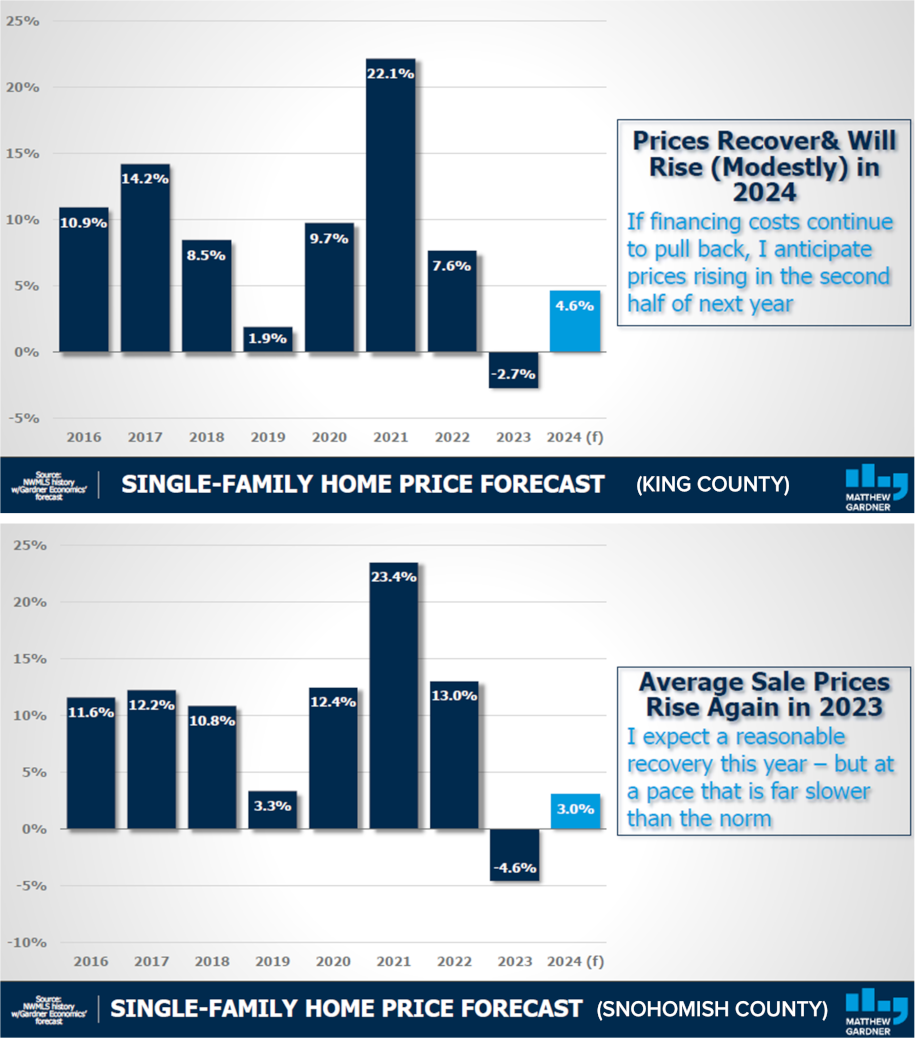
Last week, my office hosted our 16th Annual Economic Forecast Event featuring Matthew Gardner. Matthew is a sought-after economist focused on the national and local economies and has a deep understanding of the housing market across the country and right in our own backyard. He is an economic advisor for the State of Washington, Governors Council, lectures on real estate economics at the University of Washington, and is found quoted in various media outlets throughout the year as a respected expert. He is certainly a trusted real estate advisor that I look to to stay informed to help educate my clients.
The event was virtual and I have the recording and his PowerPoint in a PDF that I am happy to share with you, please reach out if you would like me to email it to you. So much was shared in his 60-minute presentation that was focused on the national economy and a deep dive into both King and Snohomish Counties, followed by Q & A. I can’t quite cover it all here, but here are some highlights!
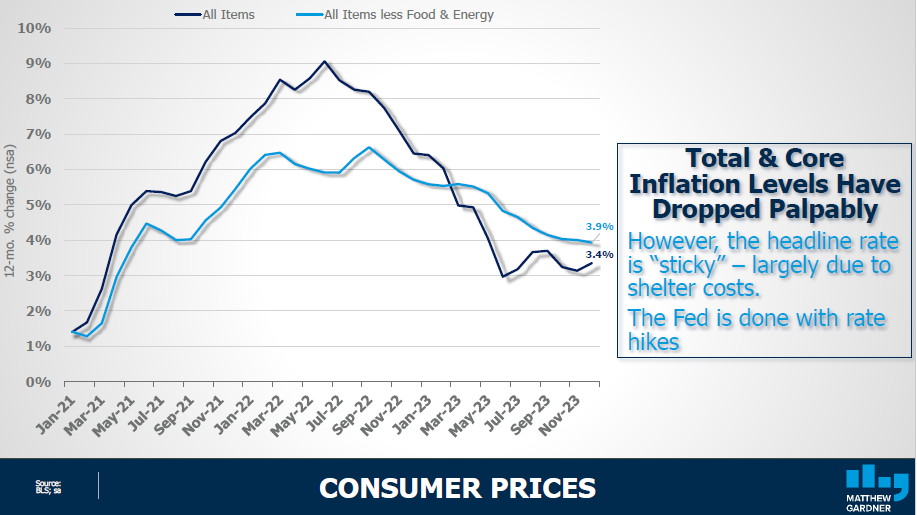
Inflation levels have dropped from their peak and are now tracking with more normalized levels. This has caused interest rates to start to drop, which is a trend he sees continuing in 2024.
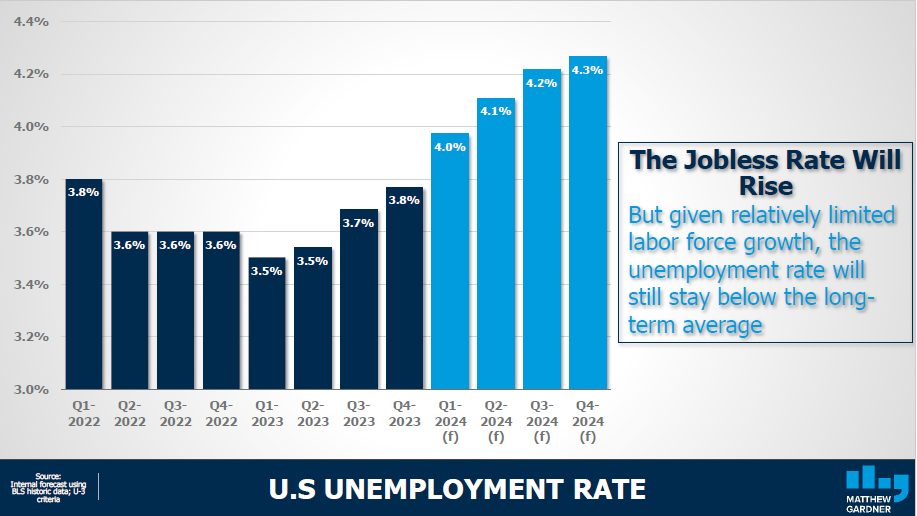
The U.S. unemployment rate measured at 3.8% at the end of 2023 and is forecasted to rise ever so slightly and remain under the long-term average of 4.5%. In King and Snohomish Counties the unemployment rate averaged 4% at the end of 2023.
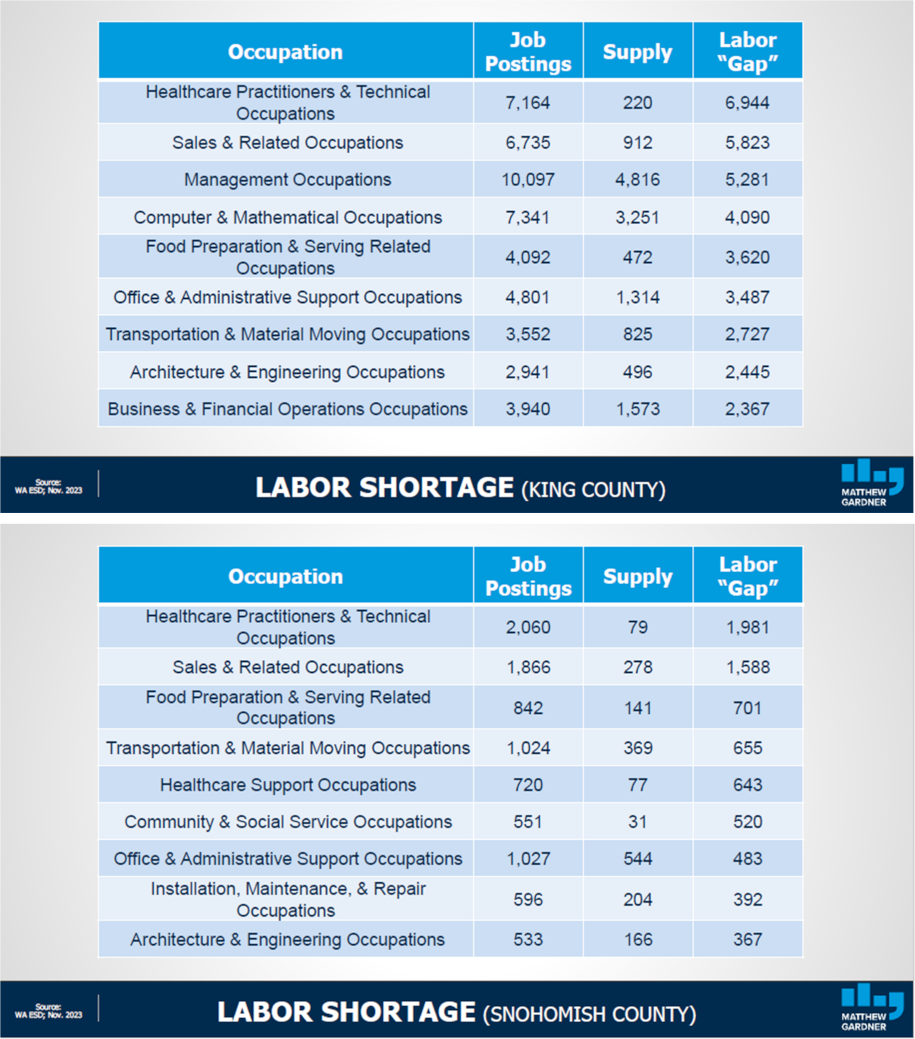
There is a major labor gap in both King and Snohomish Counties, with job postings heavily outweighing labor supply. Biotech is the darling of the moment which will balance out the IT side in the overall jobs picture.
Interest rates are predicted to gradually decrease throughout 2024 as inflation softens. The Fed will slow-play these reductions to get them right, so they do not have to raise them again.
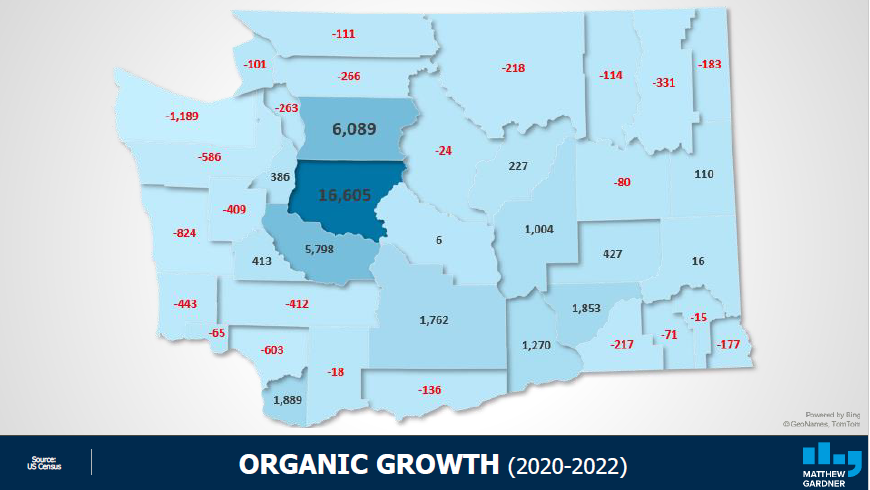
The Tri-County area of Snohomish-King-Pierce Counties had massive organic population growth from 2020-2022, much of which was international vs. domestic.
Homeowner equity averages 60% in King County and 57.5% in Snohomish County. According to the median price in King County in December 2023 that is $511,200 and $391,000 in Snohomish County. Homeownership proves to have the strongest impact on household wealth.
There will NOT be a bubble in the housing market! Given that prices remained stable in 2023 amongst the highest interest rates we’ve seen in two decades along with inflation at a high, the housing market has proven to be a fortuitous economic marker. Rates and inflation are both improving, which will bode well for home values. Our biggest challenge is the lack of inventory and affordability.
Price growth in King and Snohomish Counties was flat year-over-year (2022 to 2023) after massive growth from 2020-2022, which was positive given the correction in prices and rise in interest rates. Prices are forecasted to modestly increase in 2024. Tight inventory and continued buyer demand will drive this growth while interest rates temper.
Please reach out if you would like to learn more and receive the documents and recording. Also, you can count on me to follow the trends, statistics, and rhythm of the market throughout the year. It is my goal to gain knowledge and understanding so I can help keep you informed. This level of service helps empower my clients to make thoughtful, sound decisions when navigating their investments and big life choices.
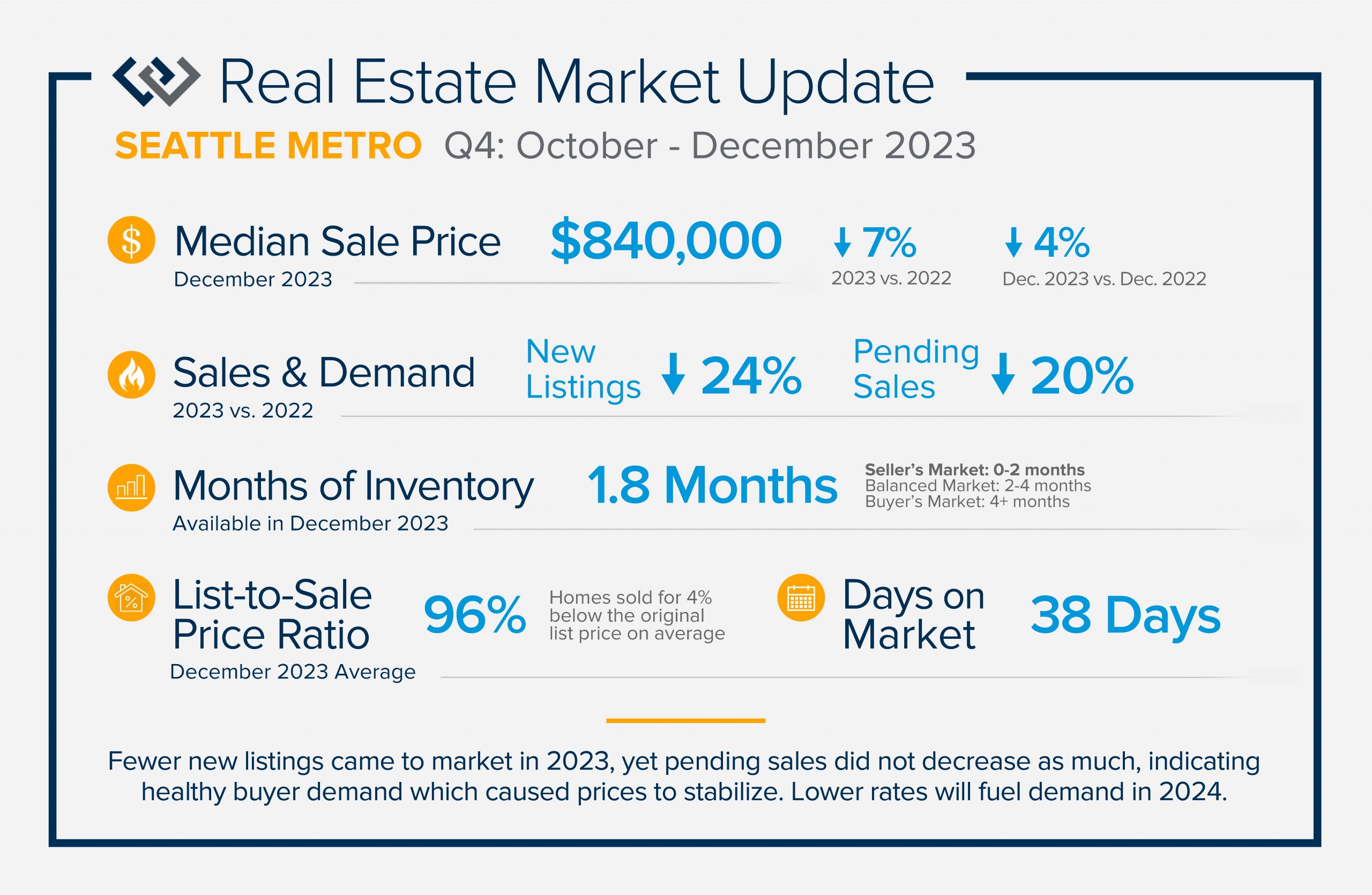
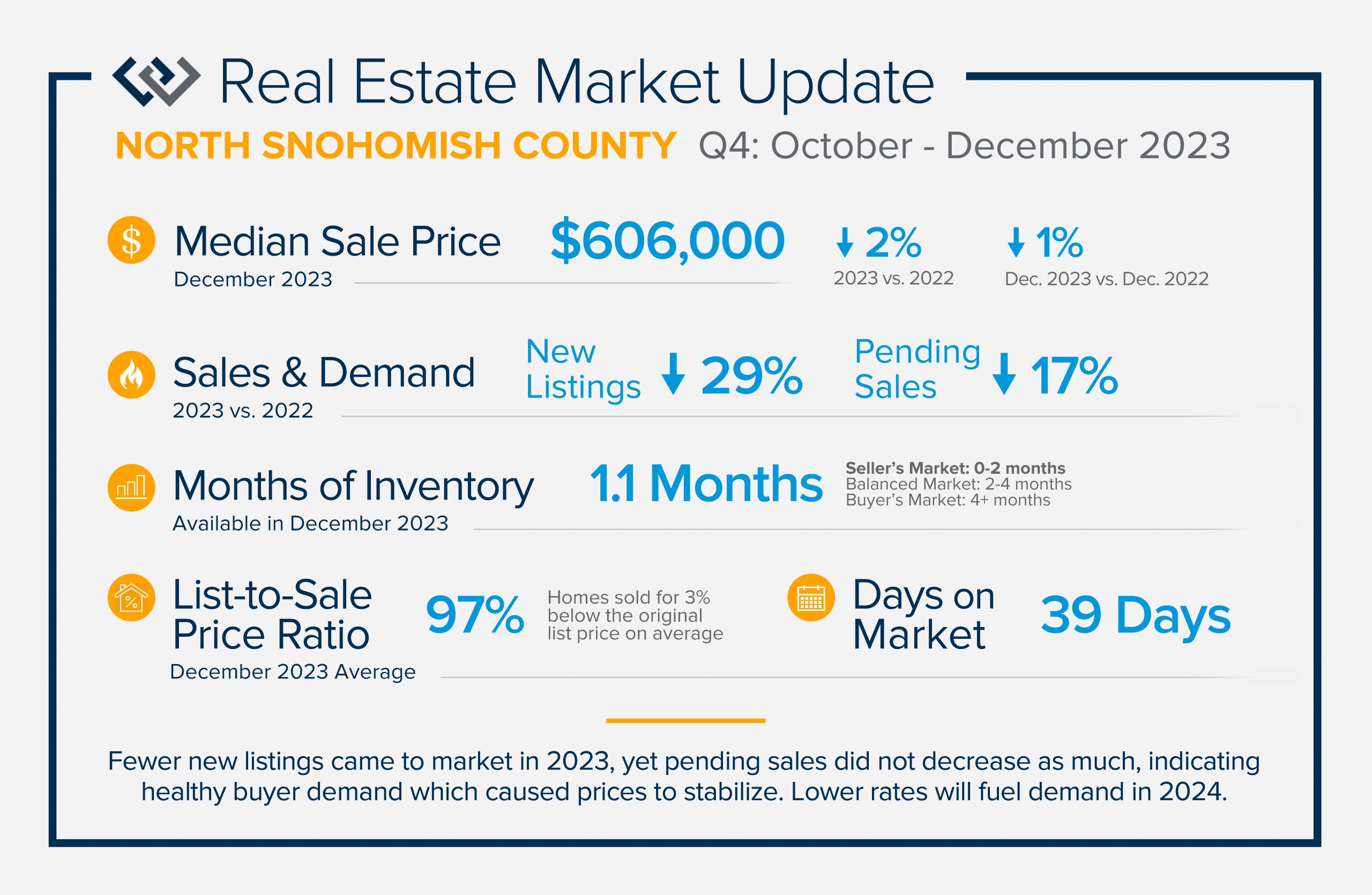
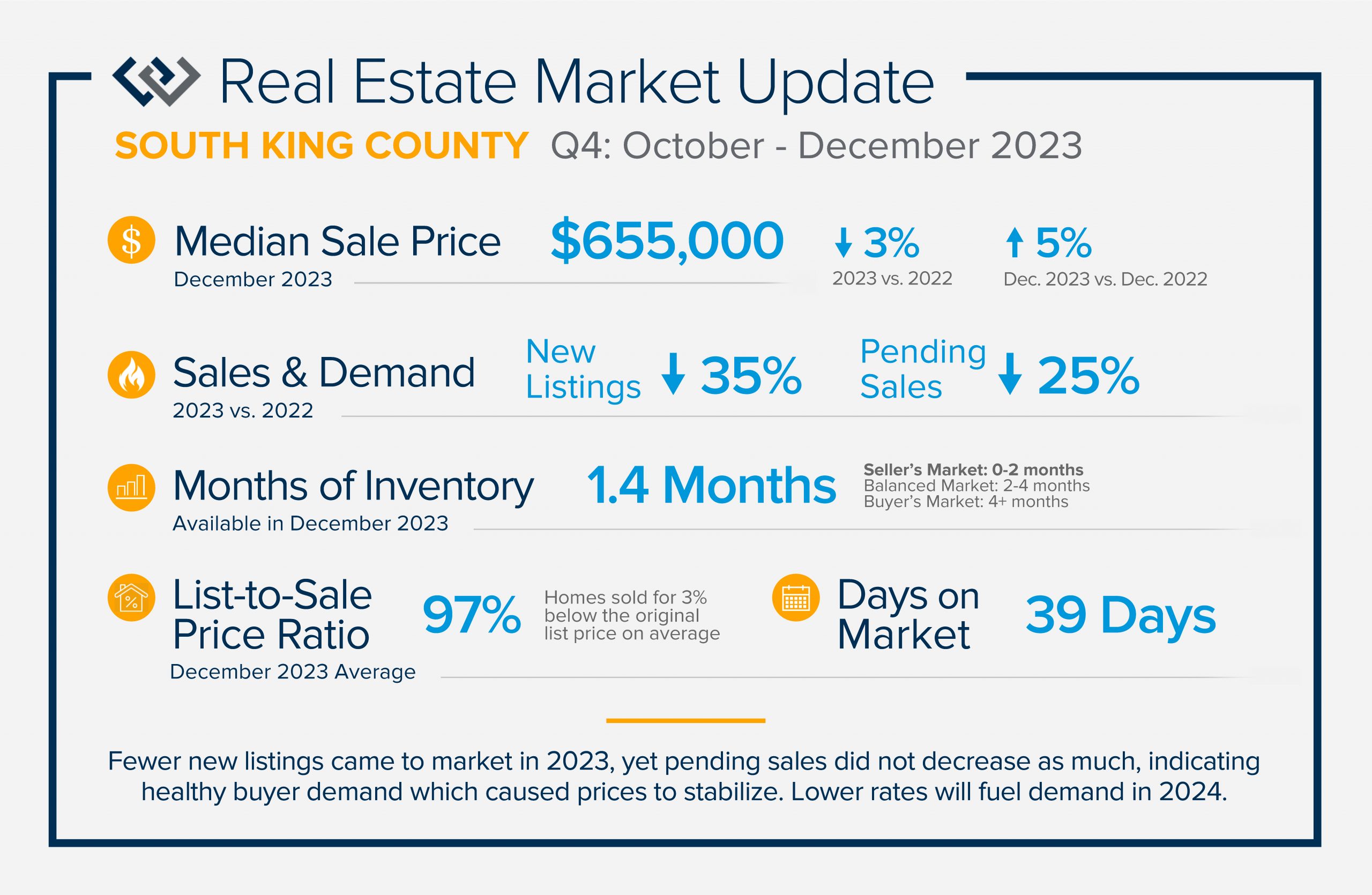
The story of 2023 was balancing interest rates with home purchases and even home sales. The average weekly rate in 2023 was 6.8% and peaked in October at 7.94%. This caused some buyers to pause due to cost. Many sellers were reluctant to move and give up their low payments based on historically low rates, hence the large decrease in new listings in 2023.
Despite the highest rates we’ve seen in two decades, pending sales did not falter like new listings, indicating continued demand and resulting in a seller’s market. Inventory remained tight throughout 2023 and prices stable over 2022 (the peak) when the average rate was 5.34%. Since October, rates have come down by over 1%, bringing more buyers to the market. The Fed plans to continue this trend in 2024 which will increase buyer activity and new listings. 2024 will provide improved opportunities for all with a less stringent lending environment.
If you are curious about how the trends relate to your goals, please reach out. I strive to keep my clients well-informed and empower strong decisions.
The video below from Matthew Gardner, Windermere’s Chief Economist, refers to the effects of constricted inventory levels on the national housing market in a higher interest rate environment. Review the localized numbers that I gathered that pertain to King and Snohomish Counties and then check out what he has to say about the national trends.
Overall, inventory has been tight in 2023! Many people made moves in the pandemic-fueled market and are deciding to stay put. They utilized the lower interest rates to secure their long-term home and don’t see a need to move anytime soon. Did you know the average person stays in their home for 10 years?
Others are not completely satisfied with their homes but feel attached to the lower rate and are pushing through the discomfort until rates settle. Some are deciding to come to market because their homes do not fit their lives anymore and some are bucking the rates and getting creative with financing. The buyers working the creative financing route with rate buy-downs will be rewarded when rates lower and prices go up.
Year-to-date new listings in King County are down 30% over 2022 and down 37% in Snohomish County. Closed sales are down 27% over 2022 in King County and down 27% in Snohomish County. Even though there have been fewer new listings year-over-year, the closed sale percentage is tracking more favorably which demonstrates buyer demand. This is why inventory is tight. In August 2023 there were 1.3 months of inventory in King County and 1.1 months in Snohomish County. This illustrates a seller’s market.
Closed sales peaked in 2021 in both counties at 20,132 in King County and 8,663 in Snohomish County. As we venture away from these outlier pandemic years, consumers are wrapping their heads around the changing environment. Year-to-date, King County has had 16,069 closed sales and 5,344 in Snohomish County. Year-to-date, King County is pacing slightly higher than 2019, which was a normal market prior to the pandemic and Snohomish County is lagging behind by just a bit.
The pace of inventory has helped stabilize prices and created price growth since the start of 2023. Buyer demand exists because people’s lives change and we have the Millennial generation out in full force. If your life is leading you to consider a move, please reach out. Please do not rely on the noise in the media, they will lead you astray.
I can help you dig into the data and devise a plan that relates to YOUR life. With equity levels astoundingly high (over 50% of homeowners in the U.S. have over 50% equity), moves are being made with great success. For buyers, the rates can be overcome with some creativity, lived with for now, or you can set a benchmark for when you’re ready. If you are curious about how today’s market relates to your goals or want to make a plan for the future, let’s talk! It is always my goal to help keep my clients informed and empower strong decisions.
Were you like me and turned the heat on when the rain came this week? It’s that time of year when our heating systems need to be attended to, to be properly prepared for the colder months ahead.
Have your air and ventilation systems inspected by the professionals to ensure efficient and healthy airflow. This will also ensure that your systems are running safely and lower your risk of fire. Note: if you need to purchase or replace any major household appliances, September and October are usually when the latest models are revealed.
Lately we have talked about life changes leading to real estate moves. Sometimes moves are brought on by joyful advancements in life and sometimes they are motivated by hardship. Then there are times when your actual house just doesn’t fit your life anymore and it is time for something different. Whatever might be calling someone to make a move, they also have to assess the affordability.
There are three aspects to affordability: price, interest rate, and income. Price and interest rate will determine your monthly payment, and your income will provide the means to maintain and build your investment. One way I have been able to help my clients strategize affordability with higher interest rates are some creative financing options.
Most often a home buyer will procure a home loan with a 30-year term and the current interest rate. In the month of August, the 30-year conventional interest rate averaged 7.25%. While 7.25% is reflective of the average over the last 30 years, it is 2-3% higher than what we have experienced over the last 5 years. According to several experts, rates are predicted to decrease as we finish out 2023 and head into 2024. That also means that it is very likely prices will increase when that happens.
I have helped some of my clients overcome the higher interest rates and secure today’s prices by helping them arrange with their lender an interest rate buy-down. Sometimes we have even been able to get the seller to financially assist in paying for the buy-down. There are two types of buy-downs: a permanent buy-down and a temporary buy-down.
A permanent buy-down requires about 3% of the purchase price to buy the rate down by a point for the 30-year term of the loan. A good rule of thumb to remember is that every 1-point in rate equals 10% in buying power. For example, if the rate is 7% and you are qualified for a home at $800,000, if the rate went down by 1 point to 6% you could now afford $880,000 and have a very similar payment. Another way to look at this is simply the monthly payment itself. An $800,000 purchase with 20% down with a 6% interest rate would save a buyer $420.82 a month vs. the payment at 7%.
A permanent buy-down is a useful tool and so is a temporary buy-down. It is actually one of the most powerful tools in today’s market. It costs far less than a permanent buy-down and with rates predicted to decrease over the next 12-18 months as inflation settles, you could easily find yourself in a position to refinance.
Here is an example, let’s say you are shopping for a house and have the same $800,000 budget and a 20% down payment with today’s rate of 7%. The monthly principal and interest payment would be $4,257.94. You could do a 2-1 buydown (2 points lower in year one and 1 point lower in year 2) which would have your payment in year one be based on an interest rate of 5% with a monthly principal and interest payment of $3,435.66 – a savings of $822.28 a month. For year two, the monthly principal and interest would be based on 6%, resulting in a monthly payment of $3,837.12, a $420.82 savings. The total savings in monthly payments with the 2-1 buy-down over the two years would be $14,917.18.
The roughly $15,000 in monthly payment savings is paid upfront at closing and in some cases paid by the seller. The buyer still needs to qualify based on the 7% interest rate as the payments will convert to the payment based on the 7% in year three moving forward. The strategy here is to never have the payment increase to 7% amount because the buyer plans to refinance when rates come down and will permanently fix their rate below 7%. A bonus is that if the entire $15,000 credit has not been used yet, in some cases those funds can be applied towards the refinance.
This strategy has been effective in helping buyers secure a monthly payment that is more affordable so they can make a move now based on life’s needs and wants. It also helps them secure today’s prices. If we find a home that has had a little longer market time, a home seller is likely to assist with the $15,000 credit vs. reducing their price by 3% to accommodate a lower payment for 30 years. The temporary assistance in reducing the payment for 1 to 2 years is a viable tool for both the buyer and seller to create a win-win.
I felt it was important to bring these options to light and to encourage people to not just take today’s market at face value. Creativity, collaboration, and calm have led to some of the most rewarding sales this year for both buyers and sellers. When people logically work together to accomplish moves in an environment that seems difficult, they find success. Ultimately, I am here to help my clients match their real estate to their lives despite where the rates are today.
I love rolling up my sleeves and creating a plan to help my buyers and sellers accomplish their goals. It is my mission to help keep my clients informed and empower strong decisions. If you or someone you know are curious about how today’s market matches your needs, please reach out.
Thank you to everyone who pitched in during the Summer Food Drive! Through your generosity, we collectively donated $3,060 and 1,503 pounds of food to Volunteers of America Western Washington food banks! This is all going directly into our communities to help our neighbors in need.
There has always been a direct correlation between interest rates and home prices. The rule of thumb has always been when rates go up prices go down, and vice versa. This was temporarily proven true in the summer of 2022 when rates quickly rose by 2% (3.5%-5.5%) over 5 months. It created a price correction in the second half of 2022 as buyers retreated from the market due to affordability. One should note that price acceleration was rapid from May 2020 to May 2022 and in that two-year period prices grew upward of 50% in King and Snohomish Counties. That was an unsustainable pace. In all honesty, this was inflation’s role in the housing market, and increasing the rates was the Fed’s way of getting control.
While there was a correction from May 2022 to January 2023, since then prices have started to grow again despite the rates hovering in the 6-7% range. In fact, the median price is up from the bottom (Jan/Feb 2023) by 13% in King County and 9% in Snohomish County. Further, the median price in July 2023 was even with July 2022 in King County and down by only 2% in Snohomish County. This is a sign of price stabilization. Historically, the impact rising rates have on prices year-over-year is not negative. We are in the midst of proving that same theory.
Believe it or not, the higher rates are keeping prices stable because it is limiting the available inventory for sale. You see, there are plenty of buyers out looking for homes right now, and inventory levels are tight because potential sellers are waiting to make a move because they are holding on to their low rate. Our job market is good, we have people moving to our area and the millennials are out in full force searching for their first homes.
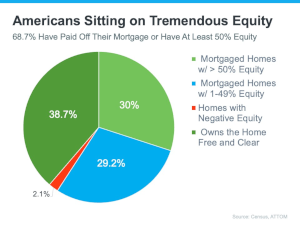
There are two interesting phenomena going on with potential home sellers right now. First, according to ATTOM Data, 68.7% of homeowners have at least 50% equity and only 2.1% have negative equity. This is the number one indicator that we are not in a housing crisis or bubble. Second, according to FHFA, 70% of homeowners with a mortgage have a rate 4% or lower. This is causing people who are no longer happy with where they live to stay a bit longer because they don’t want to give up their payment just yet.
Here’s the deal though, housing is a reflection of life! According to the US Census, 66% of homeowners would like to upgrade to a nicer home with features that better match their lifestyle, and 45% would like to move to a home to better match the changing size of their household. Life changes motivate moves! Many people are waiting out these life changes until rates come down so they can better afford their desired transition. This has put downward pressure on inventory, limiting selection for buyers, hence creating price growth and stabilization.
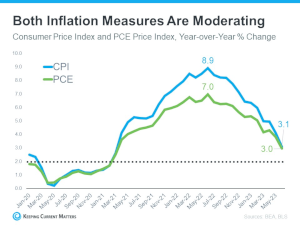
So, what is going to happen when rates come down? Experts across the board predict that rates will recede as inflation gains control. This will be a gradual process over the next 12-18 months. The biggest indicator will be inflation reaching the 2% year-over-year mark. Once we hit this point, which we are close to, experts predict the Fed will be comfortable easing off the higher rates. This will cause more homes to come to market as the delta between the rate a homeowner currently holds and what they are willing to take on to indulge their desire to move, will become more attainable. Plus, as rates recede it will increase buyer demand.
We find ourselves in a delicate dance with inflation, rates, inventory, and prices. Someone who desires a move has to consider the impact the rates can have on their payment. Many of these buyers are taking the leap and finding creative ways to offset the rate such as ARM financing, rate buy downs, or they are preparing to re-finance their purchase when rates come down. This way they will have secured a good price which is the basis of their loan.
So, do you stay or do you go? According, to the lyrics from the classic song from The Clash, “ifI stay there will be trouble, but if I go there will be double.” This is up to you to decide. Where I can help is to gather the data and help you analyze the market in order to empower you to make the best choice for you and your family. For some, the right time is now and for others, waiting a bit longer will be a good plan.
What I do know, is that when we hit the inflation rate that the Fed is comfortable with and they ease off of rates, the market will tilt. This will be a benefit for some and a challenge for others. In other words, there is not one right answer for everyone and that is where I think I have the opportunity to serve my clients best.
Helping people navigate the ever-changing market is a skill, an art, and a calling. I am here for it and find great satisfaction in helping people make big life decisions that help bring joy, solve problems, and make them money! My job is a huge responsibility and it is an honor to serve my clients. If you or someone you know are wondering about how today’s market conditions affect your goals, please reach out. We can dig into the data, assess your dreams and devise a plan.
I think we can all agree that we have been on a bit of a wild ride over the last 12 months in the real estate market. When the Fed decided to change its trajectory on interest rates in mid-2022, it created some chaos and confusion.
When big changes happen, it is a natural reaction to pause and wait for some certainty of how things will land. This happened when the pandemic hit, too. People paused in March and April of 2020 and once May settled in the market went bonkers. I have found that gathering data, whether it’s real-time data or studying historical trends, in order to make sense of it all is incredibly helpful to create clarity and empower strong decisions.
I am committed to studying the data on behalf of my clients and I am also fortunate to have Matthew Gardner, Windermere’s Chief Economist as a source to help guide this research. He speaks to the predictions that were made at the beginning of this year by several industry experts and breaks down their varied theories in this recent article. As a testament to the importance of gathering the data and applying knowledgeable analysis are the now renewed predictions from all of these sources. They are now very much more aligned with one another and in agreement that prices are not headed in a downward spiral, but are in fact on the rise year-over-year. Data is powerful!
Below is a chart I created with hyper-local data reflecting both King and Snohomish counties’ median prices over the last 18 months in relationship to the rising interest rates. While we are off the peak of 2022 when rates were at 5%, we are only slightly lower and up quite significantly from the bottom when rates hit 7%. Proof that the market is sustaining the higher rates is that we have found ourselves back near the 7% this summer and prices have not faltered.
Would the market welcome a drop in the rate? Absolutely! When this happens, which is predicted, we will see buyer demand increase. What we will also see is additional inventory come to market as would-be home sellers will be more comfortable relinquishing their low rate to indulge their need or want for a different home. The high rates are keeping inventory low in a high-rate environment, which is supporting price stabilization and growth. Simply put, the sky is not falling.
The market continues to churn, we are not in a free fall, and prices are stable. If you’ve thought about a move, consider the data and please ask me to help you gain understanding. I can adjust the graph featured here with your local zip code or city to give you an even more thorough look at your investment.
Real estate moves are most often a result of life changes. If you have found yourself questioning whether your four walls currently meet your needs, let’s talk! I will assess your goals and apply the data in an understandable way to help guide the best decision for you today or down the road.
The need for food assistance has never been greater due to the end of the Supplemental Nutrition Assistance Program’s (SNAP) Emergency Allotments and soaring food prices. As a result, more and more families across America are facing hunger. Our food banks are experiencing a surge in visitors and struggling to meet the increased demand.
The good news is that this incredible network of go-givers can do something about it! Fueled by the collective generosity that Windermere is so well known for, I’m rallying my network to come together to help us towards our goal of raising $50,000.
I would be very grateful if you considered contributing to our campaign through our donation website.

 Facebook
 X
X
 Pinterest
 Copy Link





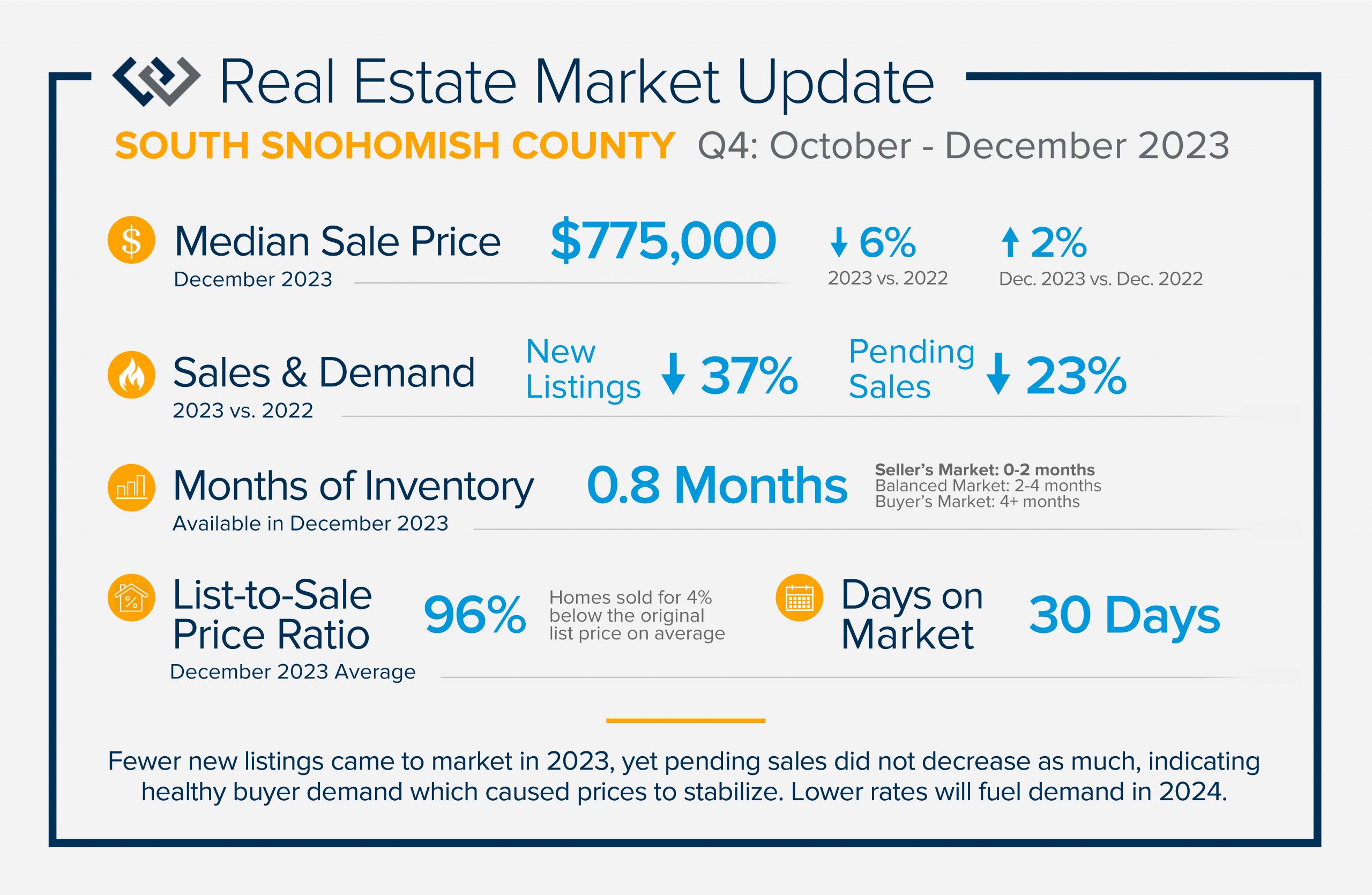
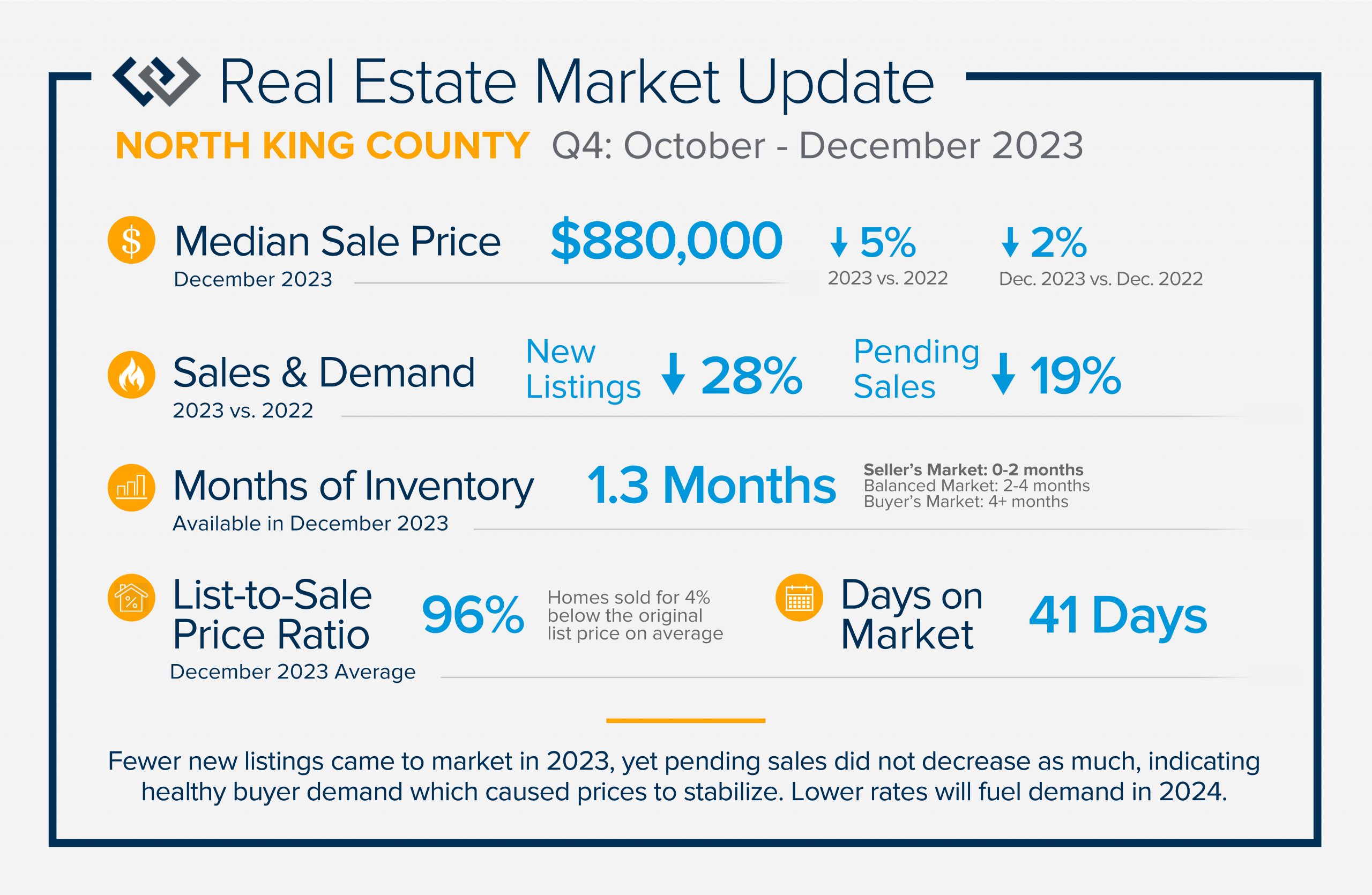 The story of 2023 was balancing interest rates with home purchases and even home sales. The average weekly rate in 2023 was 6.8% and peaked in October at 7.94%. This caused some buyers to pause due to cost. Many sellers were reluctant to move and give up their low payments based on historically low rates, hence the large decrease in new listings in 2023.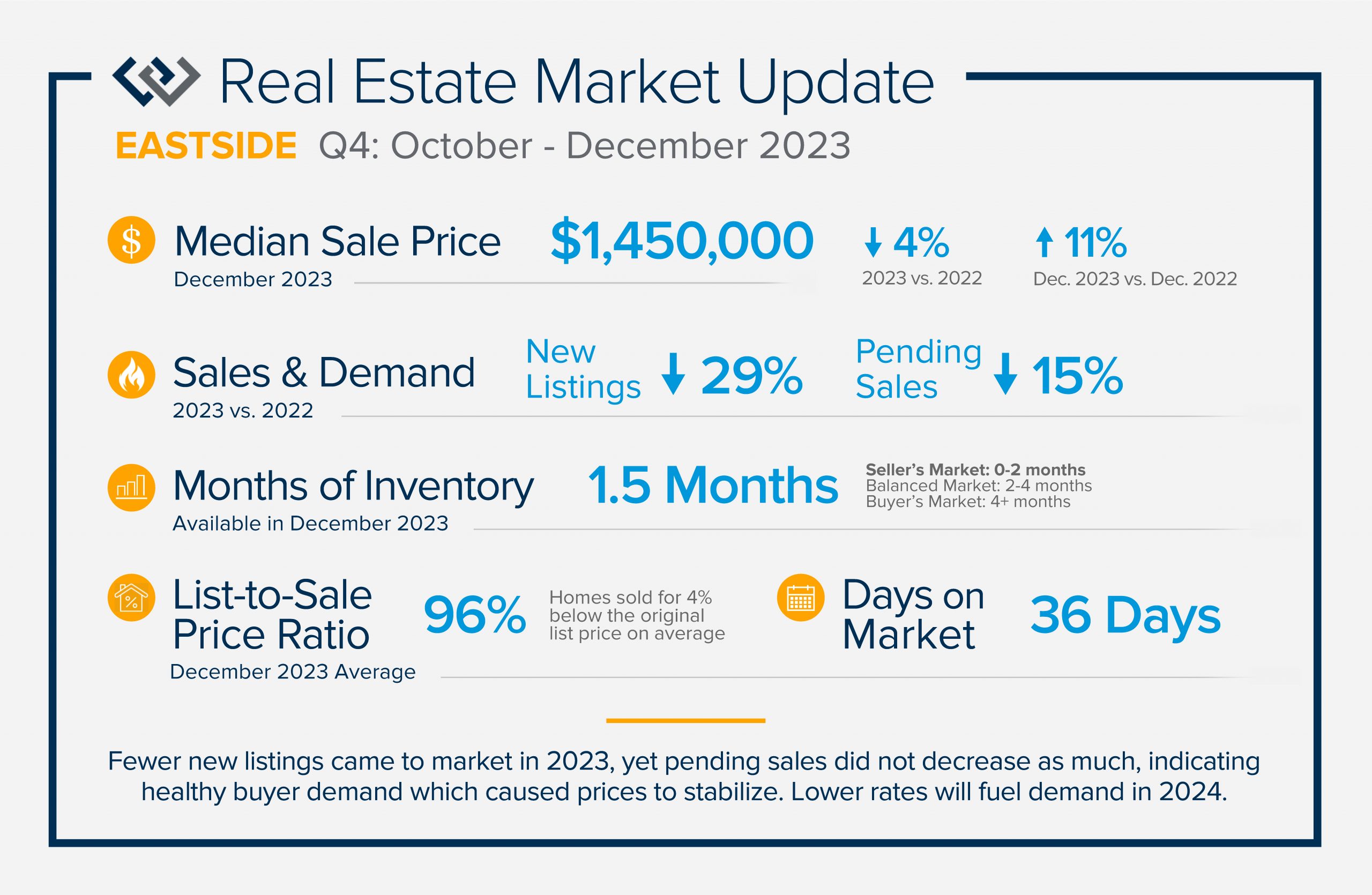




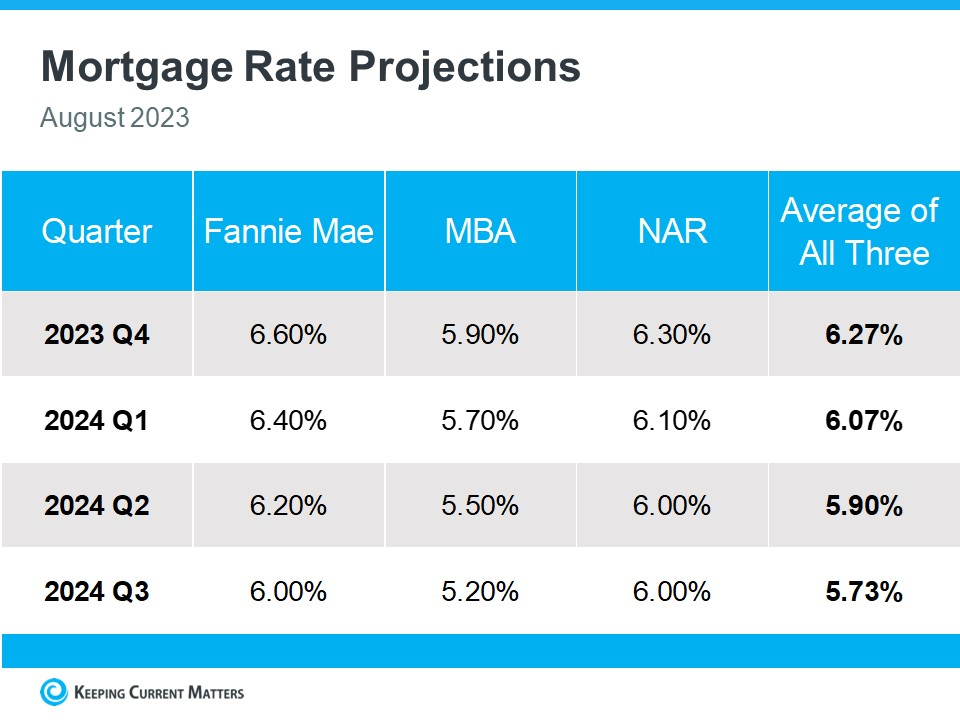 Most often a home buyer will procure a home loan with a 30-year term and the current interest rate. In the month of August, the 30-year conventional interest rate averaged 7.25%. While 7.25% is reflective of the average over the last 30 years, it is 2-3% higher than what we have experienced over the last 5 years. According to several experts, rates are predicted to decrease as we finish out 2023 and head into 2024. That also means that it is very likely prices will increase when that happens.
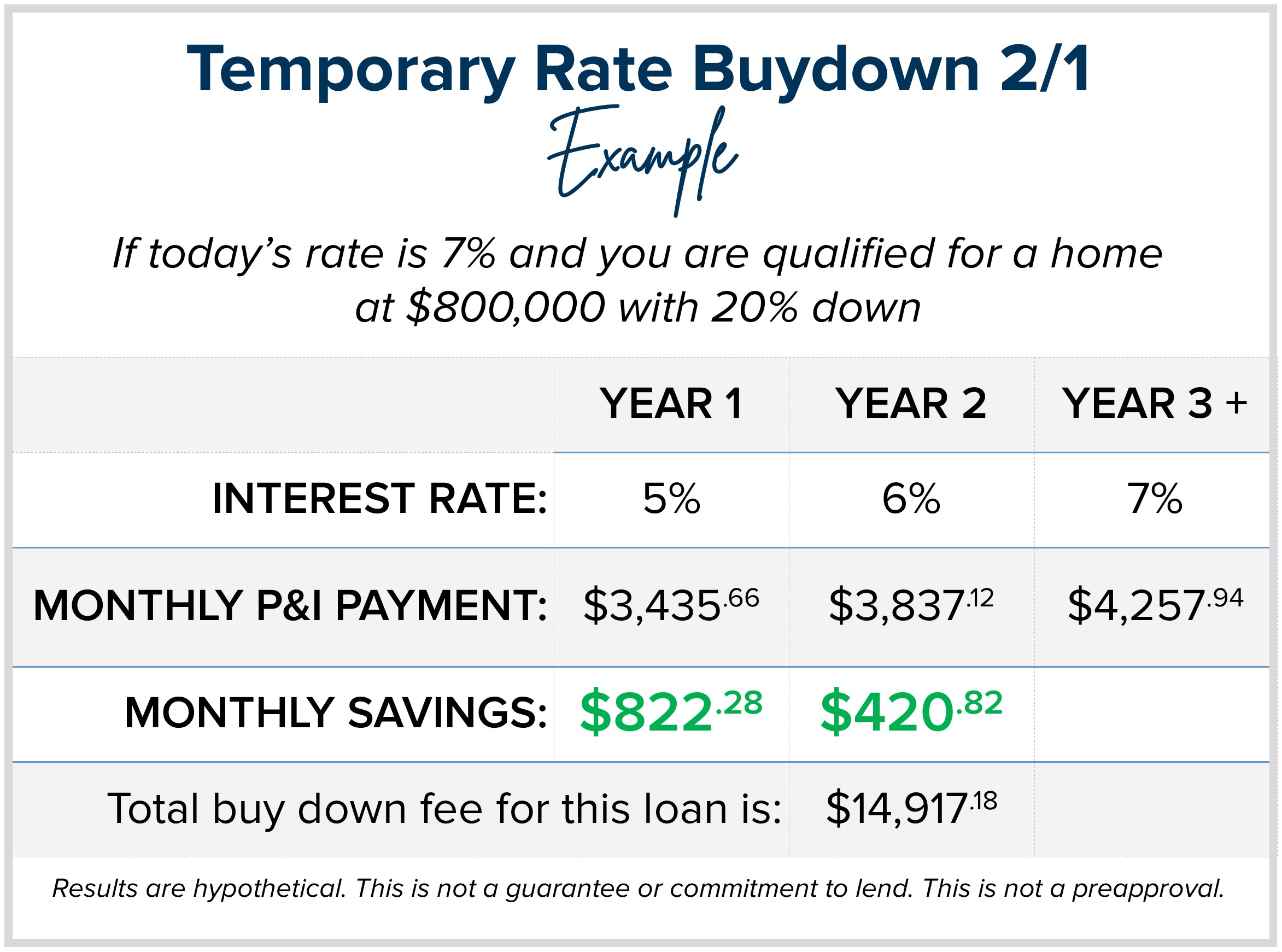 Here is an example, let’s say you are shopping for a house and have the same $800,000 budget and a 20% down payment with today’s rate of 7%. The monthly principal and interest payment would be $4,257.94. You could do a 2-1 buydown (2 points lower in year one and 1 point lower in year 2) which would have your payment in year one be based on an interest rate of 5% with a monthly principal and interest payment of $3,435.66 – a savings of $822.28 a month. For year two, the monthly principal and interest would be based on 6%, resulting in a monthly payment of $3,837.12, a $420.82 savings. The total savings in monthly payments with the 2-1 buy-down over the two years would be $14,917.18.
 Thank you to everyone who pitched in during the Summer Food Drive! Through your generosity, we collectively donated $3,060 and 1,503 pounds of food to Volunteers of America Western Washington food banks! This is all going directly into our communities to help our neighbors in need.
 There has always been a direct correlation between interest rates and home prices. The rule of thumb has always been when rates go up prices go down, and vice versa. This was temporarily proven true in the summer of 2022 when rates quickly rose by 2% (3.5%-5.5%) over 5 months. It created a price correction in the second half of 2022 as buyers retreated from the market due to affordability. One should note that price acceleration was rapid from May 2020 to May 2022 and in that two-year period prices grew upward of 50% in King and Snohomish Counties. That was an unsustainable pace. In all honesty, this was inflation’s role in the housing market, and increasing the rates was the Fed’s way of getting control.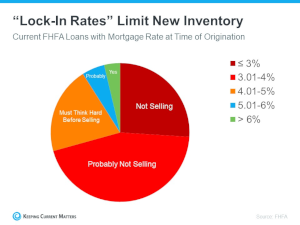
 Here’s the deal though, housing is a reflection of life! According to the US Census, 66% of homeowners would like to upgrade to a nicer home with features that better match their lifestyle, and 45% would like to move to a home to better match the changing size of their household. Life changes motivate moves! Many people are waiting out these life changes until rates come down so they can better afford their desired transition. This has put downward pressure on inventory, limiting selection for buyers, hence creating price growth and stabilization.
 We find ourselves in a delicate dance with inflation, rates, inventory, and prices. Someone who desires a move has to consider the impact the rates can have on their payment. Many of these buyers are taking the leap and finding creative ways to offset the rate such as ARM financing, rate buy downs, or they are preparing to re-finance their purchase when rates come down. This way they will have secured a good price which is the basis of their loan.